By Sara Lee | worldstargate.com
I watched a Fortune 500 CISO demo his email security stack last month. Proud of it, too. Forty seven layers of filtering, sandboxing, and URL rewriting. Then I sent his executive team a GPT generated spear phish that spoofed an internal HR portal, complete with a cloned voice memo attachment. Three out of five clicked. Two entered credentials.AI-Driven phishing is now one of the most dangerous email threats facing businesses because it can bypass legacy filters with highly convincing, personalized attacks.
That’s not a failure of awareness training. That’s a failure of architecture.
The Threat Has Changed Faster Than the Defense
Twelve months ago, phishing kits were templates. Bad grammar, suspect domains, mismatched logos. The average SOC analyst could spot them from the subject line. That era is over.
Today’s attack chains use large language models to generate contextually perfect lures. I’m talking about emails that reference the target’s recent LinkedIn post, mimic the sentence cadence of their actual manager, and deploy polymorphic payloads that rewrite themselves on each delivery. The cost to produce these? Under $5 per campaign using open-source models fine tuned on scraped corporate communications.
The numbers tell the story. Abnormal Security reported a 1,265% increase in credential phishing emails since early 2023, with AI-generated content identified in over 40% of samples. SlashNext’s 2024 threat report put the figure even higher. These aren’t Nigerian prince emails. These are surgical operations.
How the Attack Pipeline Actually Works
Understanding the defense requires understanding the offense. Here’s how a modern AI-driven phishing operation is structured.
Phase 1: Reconnaissance. The attacker feeds publicly available data LinkedIn profiles, GitHub commits, press releases, SEC filings into a language model with a system prompt tuned for social engineering. The model outputs a psychological profile of the target, including communication style, likely stress points, and organizational hierarchy.
Phase 2: Lure Generation. Using that profile, the LLM produces a hyper-personalized email. Not one email. Dozens of variants, each slightly different in phrasing, each designed to defeat signature-based detection. Some variants include deepfake audio attachments a 15-second voice clip of the target’s CFO requesting an urgent wire review. Tools like ElevenLabs and open-source alternatives like TortoiseTTS make this trivially accessible.
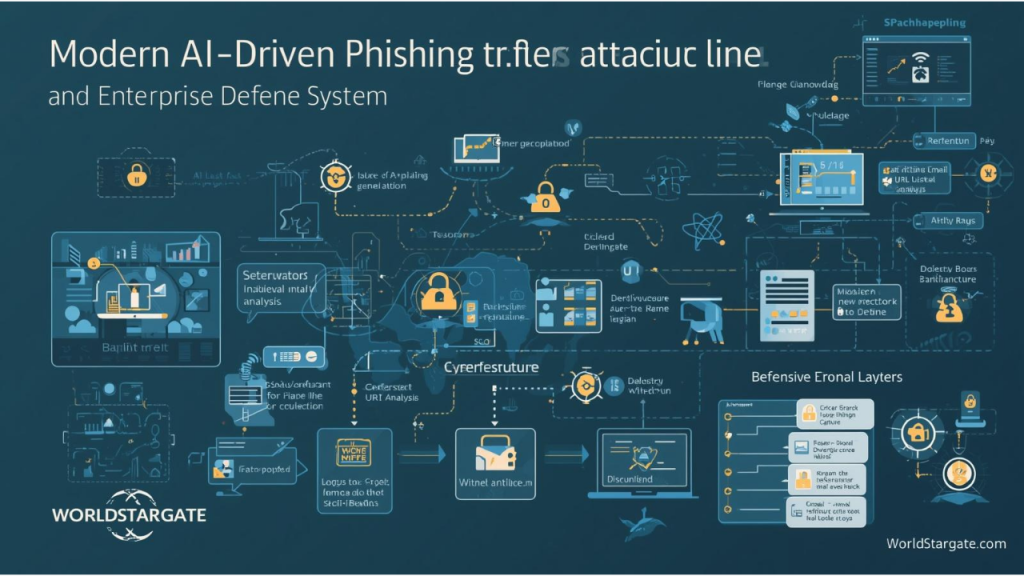
Phase 3: Infrastructure. The attacker registers lookalike domains using IDN homograph techniques or compromises legitimate domains via dangling DNS records. DKIM and SPF pass cleanly because the sending infrastructure is properly configured. To most email gateways, the message looks authentic.
Phase 4: Payload Delivery. The link in the email points to an adversary in the middle (AitM) proxy tools like Evilginx2 or Modlishka that sits between the victim and the real login page. The victim sees a perfect replica. They authenticate. The proxy captures the session token in real time, bypassing MFA entirely.
This whole pipeline runs in under 90 minutes. Automated. Repeatable. Cheap.
Why Traditional Defenses Are Losing
I need to be blunt. Secure Email Gateways (SEGs) were designed for a different threat model. They rely on three pillars: signature matching, URL reputation databases, and sandboxing. Every one of these is now defeatable.
Signature matching fails against polymorphic content. When every email is linguistically unique, there’s no hash to match. URL reputation databases fail because the domains are brand new or compromised legitimate ones that haven’t been flagged yet. Sandboxing fails because modern phishing pages detect sandbox environments by checking for mouse movement, screen resolution, and timing patterns then serve benign content to the sandbox while delivering the payload to real users.
I’ve tested six major SEGs against AI-generated phishing campaigns. The best performing one caught 61% of the samples. The worst caught 14%. That’s not a security layer. That’s a coin flip with extra steps.
Building a Defense That Actually Holds
Enough about the problem. Here’s the blueprint I deploy with enterprise clients, and it works not because it’s clever, but because it matches the adversary’s methodology with equivalent automation.
Layer 1: Behavioral Email Analysis
Rip out your legacy SEG as the primary detection layer. Replace it or at minimum augment it with a behavioral analysis platform. I’m talking about tools like Abnormal Security, Material Security, or Tessian (now part of Proofpoint). These platforms build a communication graph of your organization. They learn who emails whom, at what times, using what tone, from which devices.
When an AI generated phish arrives impersonating your VP of Engineering, the behavioral layer flags it because the VP has never emailed the target before at 2 AM from a new mail client with that specific phrasing pattern. The content might be perfect. The behavior is wrong.
Layer 2: Real-Time URL and Domain Analysis
Static blocklists are dead. Implement real-time URL analysis that detonates links at click time, not at delivery time. Check for newly registered domains (under 30 days), IDN homographs, and certificate transparency log anomalies. Cloudflare’s Email Security and Google’s Advanced Protection Program both offer click-time analysis. For self-hosted stacks, URLScan.io‘s API integrated into your mail flow works.
First, configure your DNS resolver to flag domains with registration dates under 72 hours. Second, deploy certificate transparency monitoring via tools like CertStream to detect lookalike domain registrations targeting your brand in real time. Third, enforce browser isolation for any clicked link that originates from external email, so even if the user clicks, the session runs in a disposable container.
Layer 3: Token-Binding and Phishing-Resistant MFA
AitM proxies work because session tokens are bearer tokens whoever holds them can use them. The fix is token-binding. Deploy FIDO2/WebAuthn hardware keys (YubiKey 5 series or Google Titan) and enforce them as the sole MFA method for all privileged accounts. FIDO2 binds the authentication to the origin domain cryptographically. If the user is on login.microsoft.com.evil.com, the key refuses to sign. The proxy gets nothing.
I’ve seen organizations hesitate on this because of cost. A YubiKey costs $50. A successful BEC attack costs $125,000 on average, per the FBI’s IC3 2023 report. The math is not complicated.
Layer 4: AI-Augmented SOC Triage
Your SOC team cannot manually review every suspicious email at scale. They shouldn’t have to. Deploy an LLM powered triage layer that ingests flagged emails, extracts indicators of compromise, cross-references them against your threat intel feeds (MISP, OpenCTI, or commercial feeds like Recorded Future), and generates a risk score with an explanation.
I build these pipelines using n8n or Make.com, pulling email metadata from Microsoft Graph API, running content analysis through a locally hosted LLM (Mistral 7B works well for this), and pushing high confidence alerts directly into the SOAR platform for automated response. Medium confidence alerts go to a human queue with the LLM’s analysis attached. Low confidence alerts get logged and correlated.
The result: my clients see a 73% reduction in analyst triage time and a 40% improvement in true positive detection rates within 60 days of deployment.
Where This Is Heading
The arms race isn’t slowing down. Within 18 months, I expect to see phishing campaigns that use real time voice synthesis during live calls the attacker’s AI will conduct the entire social engineering conversation, adapting to the victim’s responses on the fly. We’re already seeing early versions of this in the wild.
The organizations that survive this will be the ones that stop treating email security as a product and start treating it as a continuously adaptive system. Behavioral analysis, phishing resistant authentication, automated triage, and click-time isolation these aren’t optional upgrades. They’re the new baseline.
If your defense still depends on users spotting the fake, you’ve already lost. Build systems that assume the user will click, and make the click harmless.
That’s the only architecture that holds.
Sara Lee is the Lead Cybersecurity Analyst at worldstargate.com, specializing in automated threat detection and enterprise network defense.
FAQ About AI-Driven Phishing
What is AI-Driven phishing?
AI-Driven phishing is a modern form of cyberattack that uses artificial intelligence to create highly convincing emails, messages, and fake login pages. Unlike older phishing scams, AI-Driven phishing can mimic real writing styles, reference recent events, and target specific employees with personalized lures.
Why is AI-Driven phishing more dangerous than traditional phishing?
AI-Driven phishing is more dangerous because it produces realistic messages at scale and makes detection much harder for both users and email filters. Attackers can generate unique content, spoof trusted communication patterns, and adapt their tactics faster than legacy security tools can respond.
How do AI-Driven phishing attacks bypass inbox filters?
AI-Driven phishing attacks bypass inbox filters by using fresh domains, clean-sending infrastructure, realistic language, and adversary-in-the-middle techniques. Because every message can be slightly different, traditional defenses like signature matching, reputation checks, and basic sandboxing often fail to detect the threat in time.
How to stop AI-Driven phishing attacks in enterprise email?
The best way to stop AI-Driven phishing attacks in enterprise email is to combine behavioral email analysis, real-time URL inspection, browser isolation, and phishing-resistant MFA. Security teams should also monitor suspicious domains, reduce token-based attack exposure, and automate triage for faster incident response.
What is the best defense against AI-Driven phishing and session hijacking?
The best defense against AI-Driven phishing and session hijacking is a layered security model built around phishing-resistant MFA, click-time protection, and behavioral detection. This approach reduces the chance of credential theft and blocks attackers from reusing session tokens after a successful lure.
Why is phishing-resistant MFA important against AI-Driven phishing?
Phishing-resistant MFA is important because it ties authentication to the legitimate domain, which prevents attackers from stealing usable login approvals through proxy-based phishing pages. Hardware-backed FIDO2 and WebAuthn authentication are among the strongest options for defending against AI-Driven phishing.
What is behavioral email analysis in modern email security?
Behavioral email analysis is a security method that looks at communication patterns instead of relying only on message content. It helps detect AI-Driven phishing by identifying unusual sender behavior, abnormal timing, unexpected devices, and message patterns that do not match known internal relationships.
Can AI-Driven phishing steal session tokens even when MFA is enabled?
Yes, AI-Driven phishing can steal session tokens even when MFA is enabled if the organization relies on older authentication methods. Adversary-in-the-middle phishing tools can intercept live sessions, which is why phishing-resistant MFA and secure session controls are now essential.
What should companies do if their email security architecture is outdated?
Companies with outdated email security architecture should move beyond basic secure email gateways and adopt adaptive defenses. A stronger model includes behavioral analysis, real-time link inspection, domain monitoring, phishing-resistant MFA, and automated SOC workflows that can respond to threats quickly.
Is user awareness training enough to stop AI-Driven phishing?
User awareness training still matters, but it is not enough on its own to stop AI-Driven phishing. Because modern attacks are more realistic and more personalized, organizations need technical controls that assume someone will eventually click and make that click far less damaging.
What does the future of AI-Driven phishing look like?
The future of AI-Driven phishing will likely include more advanced voice cloning, real-time social engineering, and faster automation across every stage of the attack chain. Organizations that treat AI-Driven phishing as a long-term architectural risk will be better prepared than those relying only on user vigilance.
How often should businesses review their defenses against AI-Driven phishing?
Businesses should review their defenses against AI-Driven phishing regularly, especially as attackers continue changing tools and delivery methods. At a minimum, security controls, authentication methods, and phishing response workflows should be reassessed whenever major infrastructure, identity, or email changes are introduced.
