Australia energy transition The energy transition is often discussed through a single image: a new source of generation replacing an old one. The reality is more connected. Electricity reaches households and businesses through networks, relies on systems that balance supply and demand and is shaped by investment decisions made over many years. A clear discussion needs to distinguish the operation of the grid from the cost pressures on a household and from the choices an individual can make about energy use.
Australians experience energy through a bill, an appliance, a power outage or a local project. Governments and system operators consider generation capacity, transmission, storage, reliability, regulation and long term demand. These perspectives overlap but are not identical. A development that improves the system over time may not be immediately visible in a household bill, and a change in a bill can reflect several costs beyond the source of electricity itself.
Why Australia energy transition matters
Energy reporting is most useful when it makes these links visible. It can explain what a policy or project is designed to change, what uncertainty remains and which time frame applies. That is more valuable than treating every change as instant proof of success or failure for the entire system.
The grid needs reliable balance
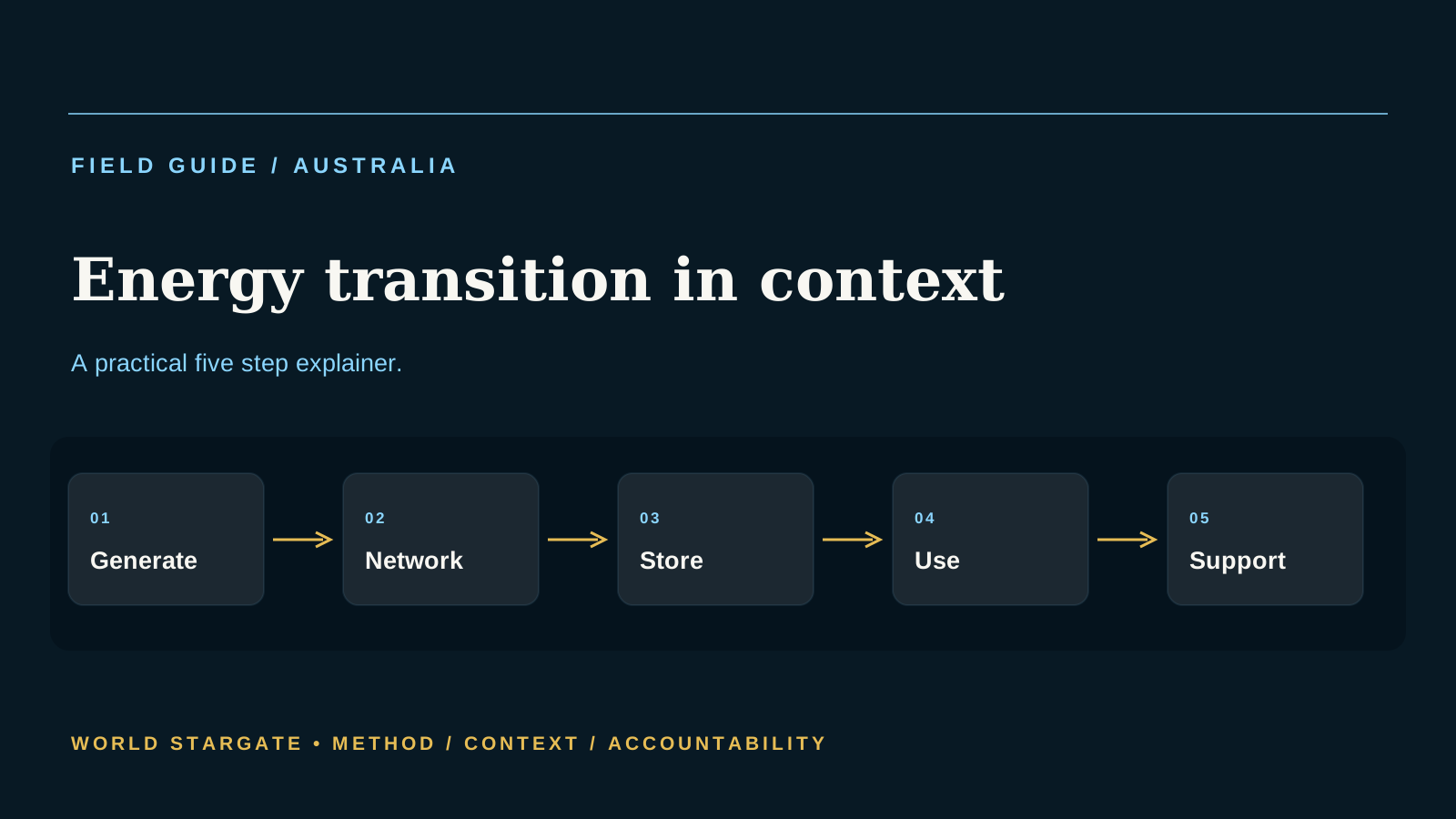
Electricity systems must match supply and demand continuously. Different generation sources, storage, network capacity and operational reserves all contribute to that task. Reliability is not only about the presence of a power station or a battery. It is about whether the system can respond to changing demand, weather, maintenance and unexpected events. Understanding that balance helps explain why planning and coordination matter alongside new generation.
For Australian readers, the key is to separate a useful national indicator from the experience of a particular household, city or industry. The broad data gives context, but the people affected by a policy or price movement may face very different constraints.
Bills include more than generation costs
A household bill can reflect wholesale prices, network costs, retail costs, policy settings, usage patterns and other charges. This does not make the generation mix irrelevant. It means a simple claim about one source of energy may not explain the bill received by a particular household. Consumers benefit from clear information about the elements they can influence, such as efficiency and usage, and the elements that are set through the wider system.
Clear definitions matter because the same word can describe several different problems. Before drawing a conclusion, identify the period, population and measure involved. That is how public discussion stays connected to evidence rather than a convenient headline.
Efficiency can reduce pressure before large projects arrive
Energy efficiency is sometimes overlooked because it is less visible than a large power project. Better insulation, efficient appliances, sensible heating and cooling settings and information about usage can reduce demand and improve comfort. The benefits vary by home, climate and ability to invest, so assistance and consumer information need to be designed with equity in mind. Efficiency is one practical way households can participate in the transition.
The question is not whether this issue matters. It is which mechanism is creating the pressure and who is most exposed. A precise answer makes it easier for communities, businesses and governments to focus on a response that fits the problem.
Networks and storage change what is possible
New generation is useful only when electricity can reach where it is needed and when it can be balanced through changing conditions. Networks and storage can help connect resources, manage peaks and improve flexibility. These investments can take time, require community engagement and involve trade offs. Clear reporting should describe the role of a project rather than assuming all infrastructure produces the same outcome.
It is also worth distinguishing a change in direction from an improvement in conditions. An indicator can ease while the level of cost, delay or disadvantage remains difficult. Time frames and local conditions need to be made explicit.
Household choice needs clear information
Consumers may be asked to make choices about appliances, rooftop systems, tariffs or energy plans. Those choices can be complex and may not suit every household. Information should be clear about up front costs, ongoing costs, eligibility and realistic savings. A good consumer policy does not assume everyone has the same home, budget, tenancy arrangement or ability to invest.
Context does not remove urgency. It directs it. A clearer explanation gives readers a better basis for judging the choices made in their name.
Read the mechanism, not only the headline
A useful Australian explanation begins by identifying the unit of analysis. A national average can illuminate a trend without describing the experience of a household, regional town, renter, worker or small enterprise. Readers should be told what is being measured, over what period and which group is included. Without those details, a number can look decisive while hiding the difference between a broad signal and the lived reality of the people most exposed to the issue.
It also matters to distinguish a change in direction from a change in level. A cost may rise more slowly while remaining difficult, an approval time may shorten while still creating delay, or an employment measure may improve while opportunities are uneven across industries and locations. Careful reporting gives readers both pieces of information. It avoids declaring success or failure too early and makes room for the real constraints facing different communities.
Policy choices should be read alongside their implementation. A new rule, funding announcement or public strategy can set an intention, but the practical question is how people will encounter it. Who has to apply, what evidence is required, which organisation delivers the service and what happens when a case falls outside the expected path? That is where a policy becomes useful or frustrating. The answer often comes from public guidance, administration data and the experience of people using the system.
For readers, a good test is whether the story explains the mechanism rather than repeating the announcement. What is changing, who is expected to benefit, who carries the cost and what evidence would show that the approach is working? These questions create a better basis for public discussion than a promise of a simple outcome. They also help separate an understandable concern from an unsupported conclusion.
In reporting on australia energy transition, the aim is not to flatten disagreement. It is to make the assumptions visible so that readers can judge them. For Australian households, businesses and energy policy readers, that means keeping the connection between evidence, place and real consequences clear, particularly where the risk is a complex energy system being reduced to one technology or one quarterly bill outcome.
A final practical check is to write down the decision that is actually being made, the information that supports it and the point at which a person will revisit the decision. This prevents a useful explanation of australia energy transition from being used as more certainty than it can provide. It also makes it easier to notice when the source, conditions or intended outcome have changed. Good records, clear ownership and a willingness to seek specialist help when needed are signs of a considered process, not a delay for its own sake.
Readers benefit when an article names both the opportunity and the limit. The opportunity may be better information, a clearer workflow or a more informed public discussion. The limit is that an individual situation can involve facts, obligations and risks that general reporting cannot decide. Keeping that distinction visible helps people use context responsibly, ask better questions and avoid acting on a claim that has not been checked against the full circumstances.
For this reason, the most valuable next step is often a small one: read the primary material, retain the relevant records and speak to an appropriately qualified adviser or responsible organisation if the issue affects money, rights, access or safety. That approach keeps the reporting useful while respecting the uncertainty that remains in any complex decision.
Australian public issues are often easier to discuss when the evidence is connected to the place and time in which people experience it. Before accepting a broad conclusion, readers can ask whether the source describes a national trend, a state or regional condition, a particular cohort or a short period of change. They can also ask what practical step follows from the analysis and how success would be measured. This approach does not make disagreement disappear. It makes the disagreement more honest by showing which assumptions and trade offs are being made. In the case of australia energy transition, it helps Australian households, businesses and energy policy readers focus on the practical consequences rather than reducing a complex issue to a single political or economic claim.
Public reporting benefits when readers can see the gap between an indicator and a lived outcome. A change in a national measure may be important, but it can take time to affect a household, a regional community or a business with a particular set of costs. Good analysis makes that time frame clear. It also identifies where the evidence is strong, where it is incomplete and which assumption connects a policy choice to the result it is expected to deliver.
That discipline is especially useful in discussion of australia energy transition. It allows a reader to separate a factual observation from an argument about what should happen next. The observation may come from official data, a program rule or a public decision. The argument involves priorities, trade offs and different experiences. Presenting both honestly gives communities a stronger basis for debate and prevents a complex Australian issue from being framed as though one figure or announcement already answers every practical question.
Questions worth asking
- Is the claim about grid reliability, a household bill or a long term investment?
- What time frame does the proposed change operate over?
- Which costs or benefits are included in the comparison?
- How do networks and storage affect the outcome?
- What choices and constraints do households actually face?
The editorial takeaway
The Australia energy transition is a system change, not a single technology story. Readers can assess it more clearly when grid reliability, household costs, consumer choice and investment timing are kept in view together. A careful understanding of australia energy transition is more useful than a simple headline because it makes the practical trade offs visible.
Read World Stargate’s editorial policy and meet the journalists on our contributors page. This article is general information and is not energy, financial, property or legal advice.