digital asset record keeping Digital asset activity can create a record trail across exchanges, wallets, applications and transactions. That trail may be easy to overlook while accounts are active, but it becomes important when a person needs to understand what happened, reconcile balances or prepare information for tax purposes. Good records do not decide the tax treatment of a transaction. They give the person and their adviser the information needed to assess it accurately rather than relying on memory or incomplete account histories.
The details needed may include dates, transaction values, fees, the type of activity, relevant addresses and records from the service used. A person may also need to retain information about transfers between accounts they control so that an internal movement is not confused with a sale or other event. The safest approach is to create a regular process while information is still available, not to wait until a reporting deadline makes every missing entry harder to locate.
Why digital asset record keeping matters
Record keeping is often treated as administrative work. In practice, it is a form of risk management. Complete information can help a person identify an error, answer a query and seek professional advice based on the actual transaction history. It can also reduce the temptation to make assumptions about events that cannot be substantiated later.
Capture the transaction at the time it occurs
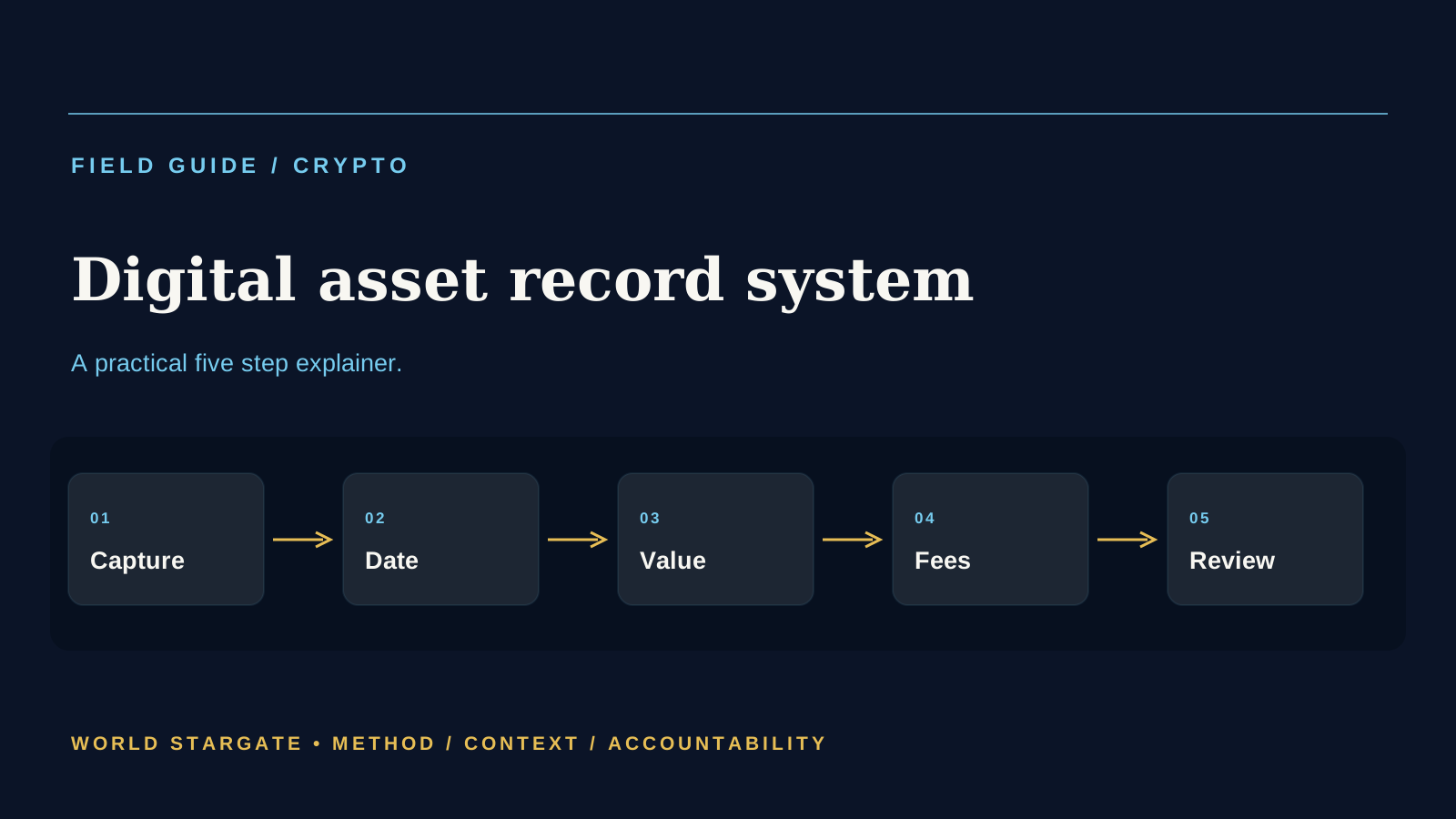
A record is most reliable when it is created or saved close to the event. Keep confirmations, account statements and relevant transaction identifiers in a controlled location. Note the date, the asset involved, the type of transaction, the value used by the service and any fees. If a transaction is part of a broader arrangement, retain the documentation that explains the purpose. Waiting until months later can leave a person searching through old emails, lost applications or platform histories that no longer show the necessary detail.
For users, the important distinction is between a technical claim and a clear explanation of the service, legal entity, custody arrangement and remaining risk. A polished interface or familiar term should not substitute for that information.
Keep transfers between your own accounts visible
A movement between wallets or accounts a person controls may need to be explained differently from a transaction with another party. Keeping the sending and receiving records together can make the history easier to follow. Record the relevant addresses, date and amount, and retain evidence that the accounts were controlled by the same person where appropriate. The aim is not to make a legal conclusion from the record. It is to preserve a clear trail for later review.
Risk is often distributed across several parties. A platform, custodian, protocol, token issuer and user may each have a role. Understanding where control sits is more useful than treating the entire arrangement as one simple product.
Include costs and fees in the record
Fees, spreads and other transaction costs can be easy to miss because they may appear separately from the headline amount. Save the information available from the platform or service and record the currency or asset in which the fee was charged. A detailed record helps prevent the history from becoming a series of rounded estimates. It also makes it easier to see why a balance or transaction value may not match a simple calculation made from a screen capture.
Good due diligence does not promise certainty. It helps a person identify what they do not yet know, recognise a claim that is too broad and decide when the risk is too difficult to assess without professional advice.
Use a consistent storage and backup process
A spreadsheet, secure record system or other organised method can be useful if it is updated consistently and backed up appropriately. Avoid storing passwords, recovery phrases or private keys in the same document as a transaction history. The objective is to make records available when needed without creating a new security problem. A monthly or quarterly routine may be easier to maintain than a large annual reconstruction, particularly for people who use more than one platform or wallet.
Clearer regulation and better disclosure can improve accountability, but they cannot eliminate market volatility, technology risk or fraud. Users should therefore assess the service itself rather than assuming a label is a guarantee.
Seek advice before making assumptions
Tax and legal treatment can depend on facts that an article cannot assess for an individual. If a transaction history is complex, incomplete or significant, seek appropriate professional advice. Provide the adviser with the underlying records rather than a summary that removes important detail. Official guidance can help a person understand what information may be relevant, but it does not replace advice tailored to their circumstances.
The responsible approach is patient and evidence led: identify the service, secure the account, read the terms and avoid acting on pressure or marketing alone.
Read the mechanism, not only the headline
Digital asset reporting needs to identify the exact service or arrangement under discussion. A token, wallet, exchange, custodian, lending product and platform account can expose a user to different risks even when they are presented together in a familiar app. The name of a technology does not explain who holds the assets, who controls access, what terms apply or what happens if the service is disrupted. Those details are more useful than broad claims about innovation or security.
Disclosure should be read as evidence, not as a substitute for judgement. A platform may describe systems, reserves, licences or partnerships, but users still need to understand the scope and limits of those statements. Ask what period the information covers, who prepared it, whether it applies to the specific product and what risk remains outside the claim. A good explanation makes uncertainty visible rather than turning a technical document into a blanket promise.
Security is partly a service issue and partly a user responsibility. Strong account credentials, multifactor authentication, a cautious approach to unsolicited contact and a clear record of transactions can reduce some common risks. They cannot remove market volatility, software failures, fraud or the possibility that a counterparty cannot meet an obligation. The practical value of good habits is that they give a person more time and information before an irreversible action is taken.
Regulation can create duties for particular services, but it should not be read as a guarantee that every asset is suitable or that every loss can be recovered. The relevant question is what protections apply to the activity in front of the user and how they can be used in practice. That may involve reading official guidance, checking a provider’s disclosures or seeking appropriate professional advice when the decision is significant.
For Australian digital asset users trying to organise transaction information, digital asset record keeping is best approached with a clear record, a slow decision process and a willingness to stop when an explanation is incomplete. That is a more reliable defence against an incomplete transaction history creating avoidable stress or errors when records are needed than a headline, a social media tip or a promotional claim.
A final practical check is to write down the decision that is actually being made, the information that supports it and the point at which a person will revisit the decision. This prevents a useful explanation of digital asset record keeping from being used as more certainty than it can provide. It also makes it easier to notice when the source, conditions or intended outcome have changed. Good records, clear ownership and a willingness to seek specialist help when needed are signs of a considered process, not a delay for its own sake.
Readers benefit when an article names both the opportunity and the limit. The opportunity may be better information, a clearer workflow or a more informed public discussion. The limit is that an individual situation can involve facts, obligations and risks that general reporting cannot decide. Keeping that distinction visible helps people use context responsibly, ask better questions and avoid acting on a claim that has not been checked against the full circumstances.
For this reason, the most valuable next step is often a small one: read the primary material, retain the relevant records and speak to an appropriately qualified adviser or responsible organisation if the issue affects money, rights, access or safety. That approach keeps the reporting useful while respecting the uncertainty that remains in any complex decision.
The most reliable digital asset decision process is deliberately unexciting. Identify the service, read the published terms, check the official source rather than an advertisement or social media post and retain a record of what was done. If an explanation relies on urgency, secret access or a promise that a risk has disappeared, it deserves more scrutiny, not less. This is especially important when the potential loss cannot easily be reversed. For Australian digital asset users trying to organise transaction information, the practical value of learning about digital asset record keeping is not that it guarantees a result. It is that it makes the point of control, the remaining uncertainty and the route for seeking help clearer before money, credentials or personal information are placed at risk.
Claims about digital assets should be judged by the service terms, the controls that can be checked and the practical route a user has for obtaining help. A technical label, a familiar brand or a widely shared promotion does not answer those questions. It is reasonable to slow down, read official information and decide that a product is too difficult to assess. That decision can be more valuable than acting quickly on an incomplete explanation or a claim that cannot be verified independently.
For readers of digital asset record keeping, keeping records also matters. Retain the relevant transaction information, service notices and support correspondence without exposing passwords or recovery credentials. This gives a person a clearer basis for seeking help if a service fails or a dispute arises. It also helps distinguish a genuine problem from a message designed to create panic. A careful process cannot remove every risk, but it can reduce the chance that uncertainty is exploited by a platform, a promotion or a scammer.
Questions worth asking
- Have I retained dates, values, fees and transaction identifiers?
- Can I explain transfers between accounts I control?
- Are supporting statements and confirmations stored securely?
- Is the record system backed up without storing sensitive credentials?
- Do I need professional advice before drawing a tax conclusion?
The editorial takeaway
Digital asset record keeping is easier when it is routine. A clear history of transactions, values and supporting documents gives users a stronger foundation before tax time or any later review. A careful understanding of digital asset record keeping is more useful than a simple headline because it makes the practical trade offs visible.
Read World Stargate’s editorial policy and meet the journalists on our contributors page. This article is general information and is not personal tax, legal, financial or digital asset advice.