digital identity Australia Digital identity can make it easier to prove a fact about yourself without repeatedly handing over the same documents. Used well, it can reduce friction in accessing services and help people share only the information needed for a particular transaction. Used poorly, it can create confusion about consent, data sharing and what happens when the system makes a mistake. Public trust depends on the design choices around the technology, not the label on the service.
Australians already use many forms of online verification through banks, government services and private providers. A clearer digital identity framework can help make those interactions more consistent, but it must preserve choice and accountability. A person should be able to understand who is asking for a credential, what information will be shared, how long it will be retained and what alternative exists if they cannot or do not wish to use the digital path.
Why digital identity Australia matters
Identity is sensitive because it sits at the intersection of access, privacy and security. A good service can reduce unnecessary document sharing. A bad service can create a new concentration of data or leave people unable to resolve an error. The standard should be practical: does the service make a legitimate task easier while keeping control and redress visible?
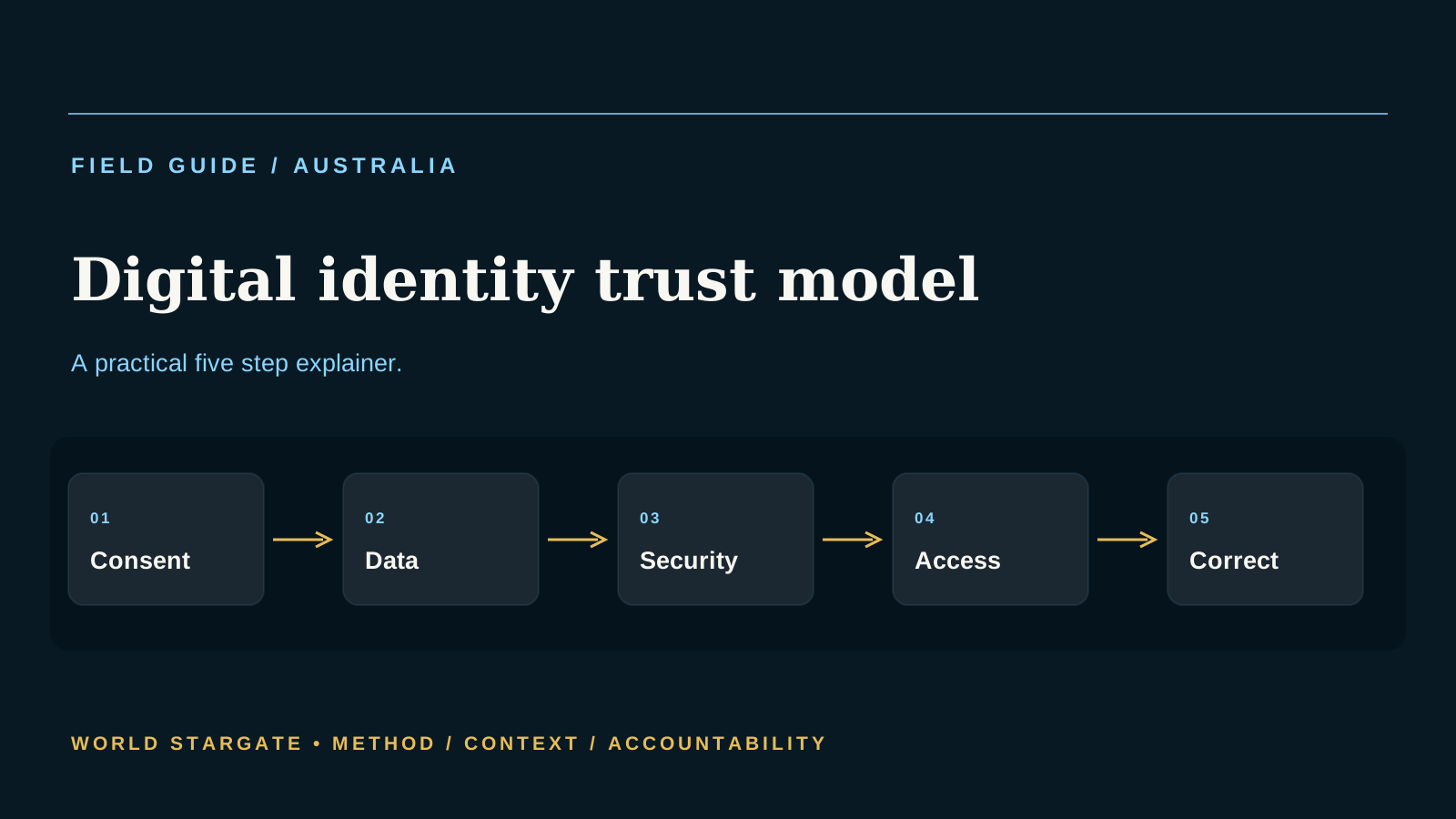
Consent needs to be specific and understandable
Consent is meaningful only when a person knows what they are agreeing to. A service should explain which attribute is being requested, such as age, address or identity verification, and why that attribute is needed. It should not rely on a broad statement that permits unlimited future use. Clear consent helps people distinguish a necessary verification from a request that asks for more information than the transaction requires.
For Australian readers, the key is to separate a useful national indicator from the experience of a particular household, city or industry. The broad data gives context, but the people affected by a policy or price movement may face very different constraints.
Share the minimum information needed
Data minimisation is a practical privacy control. If a service needs to know whether someone is over a particular age, it may not need a full copy of every identity document. If an organisation needs to verify an address, it should not automatically receive unrelated details. Designing for minimum disclosure reduces the impact if information is mishandled and gives people a clearer understanding of what has actually been shared.
Clear definitions matter because the same word can describe several different problems. Before drawing a conclusion, identify the period, population and measure involved. That is how public discussion stays connected to evidence rather than a convenient headline.
Security includes recovery from mistakes
Strong authentication and encryption matter, but security also includes what happens when a person loses access, suspects fraud or finds an error. The service should have a clear support route, a way to contest a result and safeguards against someone using another person’s identity. A system that is technically secure but impossible to correct can still cause serious harm to the individual locked out of an important service.
The question is not whether this issue matters. It is which mechanism is creating the pressure and who is most exposed. A precise answer makes it easier for communities, businesses and governments to focus on a response that fits the problem.
Accessibility and alternatives are part of fairness
Not everyone has the same device, connectivity, language confidence or ability to navigate online systems. A digital identity service should not turn a convenient option for some people into a barrier for others. Accessible design, human assistance and realistic alternatives protect fairness. They also make the service more resilient when there is an outage, a verification failure or a person has a legitimate reason to use a non digital path.
It is also worth distinguishing a change in direction from an improvement in conditions. An indicator can ease while the level of cost, delay or disadvantage remains difficult. Time frames and local conditions need to be made explicit.
Governance should be visible
People need to know who is accountable for a digital identity service, how providers are assessed, what rules apply to data use and where complaints can go. Governance can sound distant, but it becomes important when something fails. Clear responsibility gives users and organisations a route to ask questions, report concerns and understand how standards are enforced. Trust grows when accountability is visible before a crisis occurs.
Context does not remove urgency. It directs it. A clearer explanation gives readers a better basis for judging the choices made in their name.
Read the mechanism, not only the headline
A useful Australian explanation begins by identifying the unit of analysis. A national average can illuminate a trend without describing the experience of a household, regional town, renter, worker or small enterprise. Readers should be told what is being measured, over what period and which group is included. Without those details, a number can look decisive while hiding the difference between a broad signal and the lived reality of the people most exposed to the issue.
It also matters to distinguish a change in direction from a change in level. A cost may rise more slowly while remaining difficult, an approval time may shorten while still creating delay, or an employment measure may improve while opportunities are uneven across industries and locations. Careful reporting gives readers both pieces of information. It avoids declaring success or failure too early and makes room for the real constraints facing different communities.
Policy choices should be read alongside their implementation. A new rule, funding announcement or public strategy can set an intention, but the practical question is how people will encounter it. Who has to apply, what evidence is required, which organisation delivers the service and what happens when a case falls outside the expected path? That is where a policy becomes useful or frustrating. The answer often comes from public guidance, administration data and the experience of people using the system.
For readers, a good test is whether the story explains the mechanism rather than repeating the announcement. What is changing, who is expected to benefit, who carries the cost and what evidence would show that the approach is working? These questions create a better basis for public discussion than a promise of a simple outcome. They also help separate an understandable concern from an unsupported conclusion.
In reporting on digital identity australia, the aim is not to flatten disagreement. It is to make the assumptions visible so that readers can judge them. For Australians using digital public and private services, that means keeping the connection between evidence, place and real consequences clear, particularly where the risk is convenience being confused with permission to collect or share more information than necessary.
A final practical check is to write down the decision that is actually being made, the information that supports it and the point at which a person will revisit the decision. This prevents a useful explanation of digital identity australia from being used as more certainty than it can provide. It also makes it easier to notice when the source, conditions or intended outcome have changed. Good records, clear ownership and a willingness to seek specialist help when needed are signs of a considered process, not a delay for its own sake.
Readers benefit when an article names both the opportunity and the limit. The opportunity may be better information, a clearer workflow or a more informed public discussion. The limit is that an individual situation can involve facts, obligations and risks that general reporting cannot decide. Keeping that distinction visible helps people use context responsibly, ask better questions and avoid acting on a claim that has not been checked against the full circumstances.
For this reason, the most valuable next step is often a small one: read the primary material, retain the relevant records and speak to an appropriately qualified adviser or responsible organisation if the issue affects money, rights, access or safety. That approach keeps the reporting useful while respecting the uncertainty that remains in any complex decision.
Australian public issues are often easier to discuss when the evidence is connected to the place and time in which people experience it. Before accepting a broad conclusion, readers can ask whether the source describes a national trend, a state or regional condition, a particular cohort or a short period of change. They can also ask what practical step follows from the analysis and how success would be measured. This approach does not make disagreement disappear. It makes the disagreement more honest by showing which assumptions and trade offs are being made. In the case of digital identity australia, it helps Australians using digital public and private services focus on the practical consequences rather than reducing a complex issue to a single political or economic claim.
Public reporting benefits when readers can see the gap between an indicator and a lived outcome. A change in a national measure may be important, but it can take time to affect a household, a regional community or a business with a particular set of costs. Good analysis makes that time frame clear. It also identifies where the evidence is strong, where it is incomplete and which assumption connects a policy choice to the result it is expected to deliver.
That discipline is especially useful in discussion of digital identity australia. It allows a reader to separate a factual observation from an argument about what should happen next. The observation may come from official data, a program rule or a public decision. The argument involves priorities, trade offs and different experiences. Presenting both honestly gives communities a stronger basis for debate and prevents a complex Australian issue from being framed as though one figure or announcement already answers every practical question.
Questions worth asking
- What information is being requested and why?
- Can the task be completed with less data?
- Who receives the information and how long is it retained?
- What happens if a person cannot use the digital path?
- How can someone correct an error or report suspected misuse?
The editorial takeaway
Digital identity should be judged by the experience it creates for real people. A service that is clear, limited, secure and correctable can build trust. One that treats convenience as a reason to remove choice will struggle to earn it. A careful understanding of digital identity australia is more useful than a simple headline because it makes the practical trade offs visible.
Read World Stargate’s editorial policy and meet the journalists on our contributors page. This article is general information and is not legal, privacy or identity verification advice.
Primary sources
- Australian Government: digital identity
- Office of the Australian Information Commissioner: privacy guidance