regional digital inclusion A connection to the internet is not the same thing as digital inclusion. Someone may have nominal coverage but still face an expensive plan, unreliable service, an outdated device, limited digital confidence or an online form that does not work with their circumstances. In regional communities, these barriers can affect access to education, health, work, banking, government services and emergency information.
Coverage maps are useful, but they tell only part of the story. Real participation depends on whether a household can afford a suitable service, whether it works consistently enough for video appointments or online study, whether people have the skills to protect themselves from scams and whether local organisations can provide help when a system becomes confusing. The same infrastructure can produce very different outcomes depending on these conditions.
Why regional digital inclusion matters
Digital inclusion is increasingly part of economic and social participation. When essential services move online, a weak connection or lack of confidence can become a practical disadvantage. The answer is not to assume that every person wants or needs the same technology. It is to design services and support around the real constraints people experience.
Reliability matters as much as availability
A service that drops during a telehealth appointment, an online class or a business transaction can create more than inconvenience. People need to know whether the connection performs at the times and places they use it. Regional conditions, distance, weather, local capacity and household setup can influence the experience. Reporting should distinguish a service being technically available from it being reliable enough for a particular essential task.
For Australian readers, the key is to separate a useful national indicator from the experience of a particular household, city or industry. The broad data gives context, but the people affected by a policy or price movement may face very different constraints.
Affordability shapes whether people stay connected
A household may have access to a network but limit data use because the plan is expensive or unpredictable. This can affect job applications, school work, video calls and access to information. The cost of a device, repairs and software can be part of the barrier too. A digital inclusion discussion that ignores affordability risks describing access that exists only on paper.
Clear definitions matter because the same word can describe several different problems. Before drawing a conclusion, identify the period, population and measure involved. That is how public discussion stays connected to evidence rather than a convenient headline.
Skills create confidence and safety
Digital skills are not only about using an app. They include recognising a scam, managing a password, checking a source, understanding a privacy setting and knowing how to ask for help. Skills programs work best when they are practical and local. A person may not need a generic course. They may need help completing a specific form, using a health portal or protecting an account after receiving a suspicious message.
The question is not whether this issue matters. It is which mechanism is creating the pressure and who is most exposed. A precise answer makes it easier for communities, businesses and governments to focus on a response that fits the problem.
Services should work for real people
An online service can exclude people when it assumes a fast connection, a recent device, perfect English or the ability to navigate complex steps without support. Accessible design, phone support, face to face options and clear language are not a retreat from digital progress. They make digital services usable by more people and reduce the harm when technology fails at a critical moment.
It is also worth distinguishing a change in direction from an improvement in conditions. An indicator can ease while the level of cost, delay or disadvantage remains difficult. Time frames and local conditions need to be made explicit.
Local support builds lasting capability
Libraries, community groups, schools, local businesses and service organisations can make a practical difference by providing trusted places to ask questions. Support is most effective when it respects the person’s independence and focuses on the task they need to complete. A one off connection can help. Ongoing local capability makes it more likely that people can participate safely as services continue to change.
Context does not remove urgency. It directs it. A clearer explanation gives readers a better basis for judging the choices made in their name.
Read the mechanism, not only the headline
A useful Australian explanation begins by identifying the unit of analysis. A national average can illuminate a trend without describing the experience of a household, regional town, renter, worker or small enterprise. Readers should be told what is being measured, over what period and which group is included. Without those details, a number can look decisive while hiding the difference between a broad signal and the lived reality of the people most exposed to the issue.
It also matters to distinguish a change in direction from a change in level. A cost may rise more slowly while remaining difficult, an approval time may shorten while still creating delay, or an employment measure may improve while opportunities are uneven across industries and locations. Careful reporting gives readers both pieces of information. It avoids declaring success or failure too early and makes room for the real constraints facing different communities.
Policy choices should be read alongside their implementation. A new rule, funding announcement or public strategy can set an intention, but the practical question is how people will encounter it. Who has to apply, what evidence is required, which organisation delivers the service and what happens when a case falls outside the expected path? That is where a policy becomes useful or frustrating. The answer often comes from public guidance, administration data and the experience of people using the system.
For readers, a good test is whether the story explains the mechanism rather than repeating the announcement. What is changing, who is expected to benefit, who carries the cost and what evidence would show that the approach is working? These questions create a better basis for public discussion than a promise of a simple outcome. They also help separate an understandable concern from an unsupported conclusion.
In reporting on regional digital inclusion, the aim is not to flatten disagreement. It is to make the assumptions visible so that readers can judge them. For regional communities, service providers and policy readers, that means keeping the connection between evidence, place and real consequences clear, particularly where the risk is coverage claims masking the cost, reliability or usability barriers people face in daily life.
A final practical check is to write down the decision that is actually being made, the information that supports it and the point at which a person will revisit the decision. This prevents a useful explanation of regional digital inclusion from being used as more certainty than it can provide. It also makes it easier to notice when the source, conditions or intended outcome have changed. Good records, clear ownership and a willingness to seek specialist help when needed are signs of a considered process, not a delay for its own sake.
Readers benefit when an article names both the opportunity and the limit. The opportunity may be better information, a clearer workflow or a more informed public discussion. The limit is that an individual situation can involve facts, obligations and risks that general reporting cannot decide. Keeping that distinction visible helps people use context responsibly, ask better questions and avoid acting on a claim that has not been checked against the full circumstances.
For this reason, the most valuable next step is often a small one: read the primary material, retain the relevant records and speak to an appropriately qualified adviser or responsible organisation if the issue affects money, rights, access or safety. That approach keeps the reporting useful while respecting the uncertainty that remains in any complex decision.
Australian public issues are often easier to discuss when the evidence is connected to the place and time in which people experience it. Before accepting a broad conclusion, readers can ask whether the source describes a national trend, a state or regional condition, a particular cohort or a short period of change. They can also ask what practical step follows from the analysis and how success would be measured. This approach does not make disagreement disappear. It makes the disagreement more honest by showing which assumptions and trade offs are being made. In the case of regional digital inclusion, it helps regional communities, service providers and policy readers focus on the practical consequences rather than reducing a complex issue to a single political or economic claim.
Public reporting benefits when readers can see the gap between an indicator and a lived outcome. A change in a national measure may be important, but it can take time to affect a household, a regional community or a business with a particular set of costs. Good analysis makes that time frame clear. It also identifies where the evidence is strong, where it is incomplete and which assumption connects a policy choice to the result it is expected to deliver.
That discipline is especially useful in discussion of regional digital inclusion. It allows a reader to separate a factual observation from an argument about what should happen next. The observation may come from official data, a program rule or a public decision. The argument involves priorities, trade offs and different experiences. Presenting both honestly gives communities a stronger basis for debate and prevents a complex Australian issue from being framed as though one figure or announcement already answers every practical question.
Questions worth asking
- Is the connection reliable for the task people need to do?
- Can households afford the service, device and data required?
- Are digital skills and scam awareness available locally?
- Does the online service work with accessible and older devices?
- Where can a person receive human help when they are stuck?
The editorial takeaway
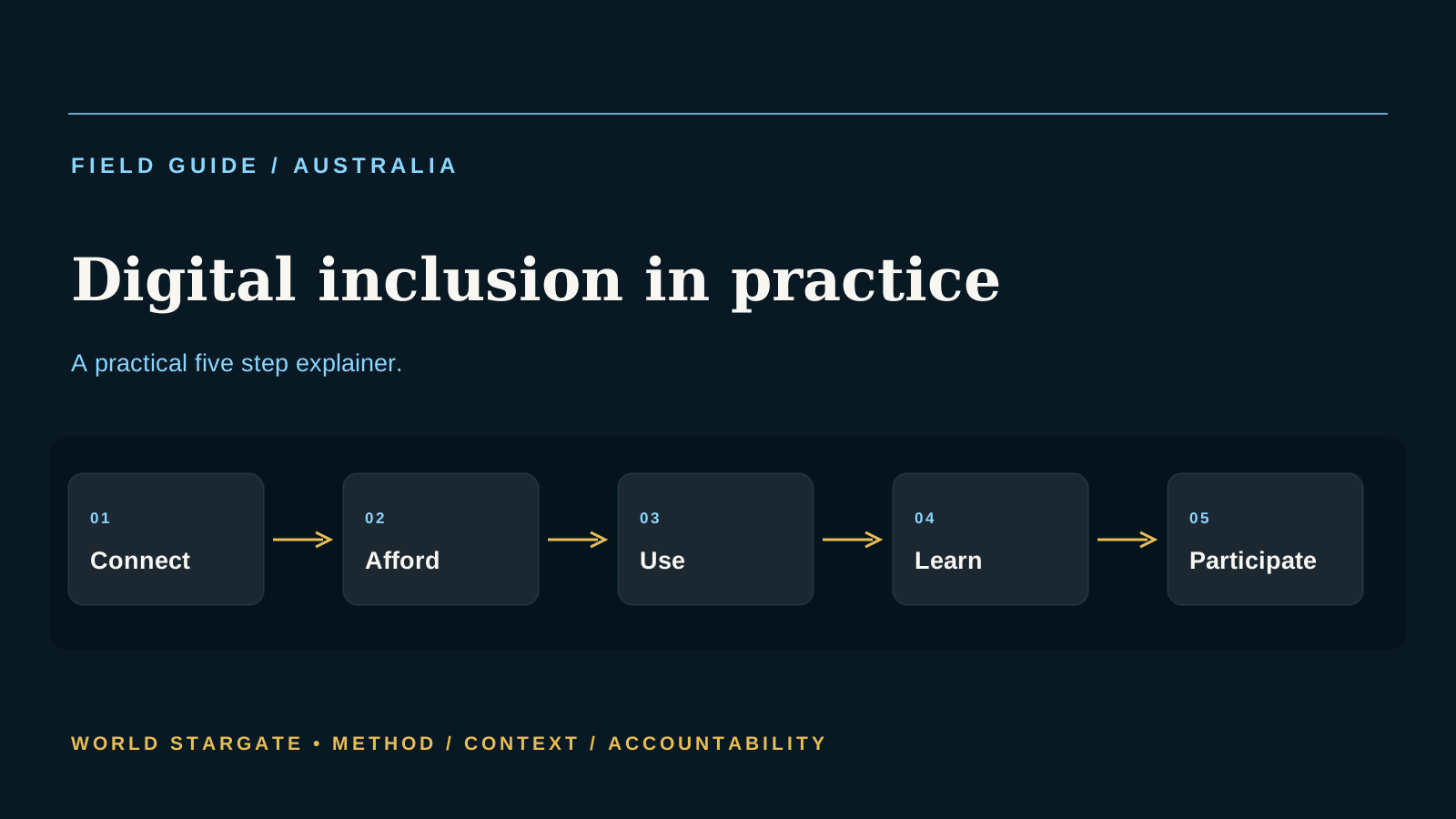
Regional digital inclusion is achieved when people can connect, afford the service, use it safely and receive help when they need it. Infrastructure matters, but it is only one part of participation. A careful understanding of regional digital inclusion is more useful than a simple headline because it makes the practical trade offs visible.
Read World Stargate’s editorial policy and meet the journalists on our contributors page. This article is general information and is not telecommunications, cyber security or policy advice.
Primary sources
- Productivity Commission: access to information and digital inclusion
- Australian Government: digital inclusion